Benefits
of Maximizing Shareholders’ Wealth
What’s
and Agency Relationship?
Real
Risk Free Rate of Interest
Nominal,
Or Quoted, Risk-Free Rate of Interest, Rfr
Chapter
2 – Risk and Return part 1
Expected
Rate of Return (payoff matrix table)
Diversifiable
Risk versus Market Risk
Chapter
3 – Risk and Return part 2
· Divide
the required rate by 2 (int/2)
· Divide
the coupon payment by 2 (pmt/2)
· Multiply
the number of payments by 2 (PMT * 2)
· Interest
Yield (or Current Yield)
Value
of Callable Bond (Equation and Formulas)
· Closely
held companies and stocks
· Initial
Public Offering (IPO)
· Expected
Capital Gains Yield
Value
of a stock with a stream of cash flows.
Constant
Growth Model (Gordon Model)
Before
Using the Constant Growth Stock
Illustrations
of Constant Growth Model
2. Find the current stock value (or
price of the stock)
Rearranged
Model for Stock Price
Price
of a Stock (given PMT and r)
Chapter
7 – Accounting Financials
Five
Uses of Future Cash Flows
Importance
of Future Cash Flows
Net
Operating Working Capital (NOWC)
NOPAT:
Net operating profit after taxes
Chapter
8 – Analysis of Financial Statements
Five
major categories of ratios
Chapter 1 – Overview
Shareholders Privileges
- Elect directors, who hire managing executives
- Directors, as representatives of the stockholders, determine manager’s compensation, rewarding them if performance is superior or replacing them if performance is poor.
Benefits of Maximizing Shareholders’ Wealth
- Customers benefit because stock price maximization requires efficient, low-cost business that produces high-quality goods and services at the lowest possible cost.
- Employees benefit because companies that successfully increase stock prices also grow and add more employees, thus benefiting society.
- Owners of the stock is the society.
What’s and Agency Relationship?
An agency relationship arises
whenever one or more individuals, call (1) hires another individual or
organization, to perform some service
(2) delegates decision-making authority to that agent.
Two Agency Problems
- Conflicts between stockholders and managers.
- Conflicts between stockholders and creditors.
Interest Rate
r = r* + IP + DRP + LP + MRP
· r = quoted, nominal, rate of interest on a given security
· r* = real risk-free rate
· IP = inflation premium
· RFR = r*+IP
· DPR = default risk premium
· LP = liquidity, or marketable premium
· MRP = market risk premium
Real Risk Free Rate of Interest
- The
interest rate that would exist on a risk-less security if no inflation
were expected (the rate on a
- It’s not static and changes over time depending on 1) rate of return on corporations and other borrowers and 2) people’s time preferences for current versus future consumption.
Inflation Premium
It erodes the purchasing power of the dollar and lowers the real rate of return on investments.
It is equal to the average expected inflation rate over the life of the security.
R t-bill = Rfr = r* + IP
Nominal, Or Quoted, Risk-Free Rate of Interest, Rfr
It is the real risk-free rate plus a premium for expected inflation: Rfr = r* + IP
Liquidity Premium
It is the liquidity a security has when market rates are established.
Market risk Premium
The Market risk premium is higher the longer the security stays in the market.
Chapter 2 – Risk and Return part 1
Expected Rate of Return (payoff matrix table)
r^ (r-hat) = (P1)(R1)+(P2)(R2) + … + PnRn[1]
Portfolio Returns
Rp = (weight 1) x (rate 1) + (weight 2) x (rate 2) + … (weight n) x (rate n)
Diversifiable Risk versus Market Risk
Diversifiable risk – is caused by such random events as lawsuits, strikes, successful and unsuccessful marketing programs, the winning or losing of a particular firm, etc.
Market risk – stems from factors that systematically affect most firms: wars, inflation, recessions, and high interest rates.
Capital Asset Pricing Model
An important tool used to analyze the relationship between risk and rate of return. The relevant risk of an individual stock is its contribution to the risk of a well-diversified portfolio.
SML equation
Required rate on Stock I = Risk Free rate + (market risk Premium) (stocks beta)
Chapter 3 – Risk and Return part 2
Capital Market Line CML
R = RFR + ((Rm – RFR)/Std Dev Market) standard dev of portfolio
Slope of Market CML
= (Rm – RFR)/Std Dev Market
Chapter 4 – Bonds
Types of Bonds:
- Treasury Bonds – government bonds, issued by Federal government and are considered to have no default risk.
- Corporate bonds – issued by firms and are exposed to default risk. Every firm has different default risk depending on the characteristics and on the terms of the bonds.
- Municipal Bonds – issued by state and local government. Interests earned on the bond are tax exempted.
- Foreign Bonds – issued by foreign governments or foreign corporations.
Characteristics of a Bond:
- Par Value – the face value of the bond. The amount the firm borrows and promises to repay on the maturity date.
- Coupon Rate – the dollar amount that is paid annually to a bondholder. It’s a fixed payment. The coupon interest rate is obtained by dividing the coupon payment by the par value of the bond.
- Floating rate – a bond’s coupon payment that vary over time (known as indexed bonds).
- Zero coupon bonds – pay no coupons, but are offered at a substantially discount below their par value, and provide a capital appreciation rather than income.
- Maturity date – the date in which the par value it paid.
- Call provision – gives the issuing firm the right to call the bonds for redemption. If bonds are called, investors are paid a premium price.
- Call protections – bonds that are not callable until x number of years after they are issued.
- Sinking fund provision – the orderly retirement of a bond issue. This can be done in one or two ways:
- The firm can call a certain percentage of the bond each year at par value.
- The firm can buy the required amount of bonds on the open market.
- Convertible bonds – bonds that are convertible into common stock.
- They have a lower coupon rate than nonconvertible debt, but they offer investors a chance for capital gains in exchange for the lower coupon rate.
- Income Bonds – pay interest only if interest is earned. These securities cannot bankrupt a company, but from an investors standpoint they are riskier than “regular” bonds.
Value of Bond (Equation)
V
b= PMT / (1+ rd) 1 + PMT/ (1+ rd) 2 + … + Par Value /
(1+ rd) n
Semi-Annual Bond
- Divide the required rate by 2 (int/2)
- Divide the coupon payment by 2 (pmt/2)
- Multiply the number of payments by 2 (PMT * 2)
Interest Rates and Bonds
- Fixed-rate bond will sell at par when its coupon interest rate is equal to the going rate of interest.
- Rate of interest is above the coupon rate, a fixed-rate bond will sell at a discount below its par value.
- Rate of interest is below the coupon rate, a fixed-rate bond will sell at a premium above its par value.
- Interest Yield (or Current Yield) – the percentage rate of return on a bond consist an interest yield (current yield), plus a capital gains yield.
Yield of a Bond (Calculation)
- Yield – the expected interest rate on a bond
- Yield to Maturity (YTM) – the rate of return earned on a bond if it is held until maturity.
- Yield to maturity can be viewed as the yield to maturity.
- Yield to maturity equals the expected rate of return only if 1) the probability of default is zero and 2) the bond cannot be called.
- Current Yield – the annual interest payment divided by the bond’s current price. Does not provide accurate measure of total expected return on a bond.
Callable Bond
If the interest rates are well below an outstanding bond’s coupon rate, then a callable bond is likely to be called, and investors should estimate the most likely rate of return on the bond as the yield to call (YTC).
Value of Callable Bond (Equation and Formulas)
V b= PMT / (1+ rd)
1 + PMT/ (1+ rd)
2 + … + Call Price/ (1+ rd)
n
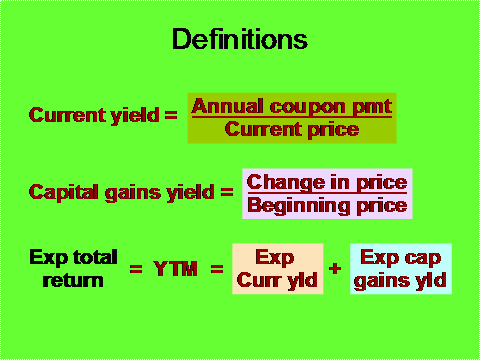
Curent Yield (CY), Capital Gains Yield (CGY), Yeild to Maturity (YTM)
YTM = Current
yield + Capital gains yield.
Cap gains yield = YTM - Current yield
Bond Rating
- Rating agencies such as Moody’s Investors Services and Standard & Poor’s Corporation
- Investment grade securities – securities with ratings of Baa/BBB or above.
Other
- Indenture – is a legal document that spells out the rights of both bondholders and the issuing corporation.
- Debenture – is an unsecured bond, and as such, it provides no lien against specific property as security fro the obligation. Holders are general creditors whose claims are protected by property not otherwise pledged.
- Reinvestment Risk Rate – the risk of a decline in income due to a drop in interest rates.
- Interest rate risk related to the value of the bonds in a portfolio, while reinvestment rate risk related to the income the portfolio produces.
- The risk that CFs will have to be
reinvested in the future at lower rates, reducing income.
- Long-term bonds: High interest rate risk, low
reinvestment rate risk.
- Short-term bonds: Low interest rate risk, high
reinvestment rate risk.
- New Issue – When a bond is first issued, it is issued at its par value. The current yield and interest rate are equal to each other.
- Seasoned issue – the classification of a bond after it has been out in the market for a while.
- Junk Bonds – high-risk and high-yield bonds.
Chapter 5 – Stock Valuation
Rights and Privileges
- Represents ownership.
- Ownership implies control.
- Stockholders elect directors.
- Directors hire management.
- Since
managers are “agents” of shareholders, their goal should be: Maximize stock price.
Proxy
- Proxy
Fight – If stockholders are dissatisfied, an outside
group may solicit the proxies in an effort to overthrow management and
take control of the business.
Preemptive Right
- Preemptive right – common stockholder’s right to purchase any additional shares sold by the firm.
- Might not be required by law.
- Enables current owners to maintain their proportionate share of ownership and control of the business.
- Prevents the sale of shares at low prices to new stockholders, which would dilute the value of the previously issued shares.
Classification of stock
- Classified stock – it’s used to meet the special need of the company. There are different types of classes such as “Class A”, “Class B”, etc.
- Class A might be entitled to receive dividends before dividends can be paid on Class B stocks.
- Class B might have the exclusive right to vote.
- Tracking Stock - The dividends of tracking stock are tied to a particular division, rather than the company as a whole.
- Investors can separately value the divisions.
- It’s easier to compensate division managers with the tracking stock.
- But tracking stock usually has no voting
rights, and the financial disclosure for the division is not as regulated
as for the company.
- Founders’ Shares – these are stocks owned by the firm’s founders that have sole voting rights but restricted dividends for a specified number of years.
- The right to vote is distinguished by
the class of share. Those with voting rights are more valuable.
Market for Common Stocks
- Closely held companies and stocks – Common stocks that are not actively traded; they are owned by only a few people, usually company managers.
- Secondary Market – deals with trading previously issued stock of established public companies. The firm does not earn money on these transactions.
- Primary Market – when additional shares are sold by the company. Here the firm earns new capital from the sell of the securities.
- Initial
Public Offering (IPO) – when a closely held company goes
public for the first time and new share offerings of shares to the public
are held.
Common Stock Valuation
- The expected cash flow consist of two elements:
- The dividends expected on each year
- The price investors expect to receive when they sell the stock.
Common Stock (Formulas)
- Expected Dividend Yield: Div 1 / Current Stock Price
- Expected Capital Gains Yield : (P1 – P0) / P0
- Expected Total Return: Exp. Div. Yield + Exp. Cap. Gains
Value of a stock with a stream of cash flows
This equation can be used if the future cash flow is rising, falling, fluctuating randomly, or if it is zero for some time.
Price of Stock = D1/ (1 + r) ^1 + D2/ (1 + r) ^2 + … + Dn/ (1 + r) ^n
If growth of stock is zero, then it is treated as perpetuity.
Expected rate = D1/price of stock
Constant Growth Model (Gordon Model)
- Model by Myron J. Gordon
- r must be greater than g.
- If g is greater than r, you will get a negative stock price.
- Only use this model if g<r and g is expected to be constant for ever.
- Dividend growth occurs as a result of growth in earning per share. Earnings growth result from factors such as 1) inflation, 2) the retained earning and reinvestment earning the firm does, 3) rate of return the company earns on its equity (ROE).
Before Using the Constant Growth Stock
The following must be true in order to use the constant growth model:
- dividends is expected to grow for ever
- stock price is expected to grow at the same rate
- expected dividend yield is a constant
- expected capital gains yield is a constant, and it is equal to g
- expected return is equal to expected dividend yield plus the expected growth rate
Illustrations of Constant Growth Model
1. Estimate Future Dividend
The firm just paid 1.15 in dividends (D0). Required rate of return is 13.4%. Growth is 8%.
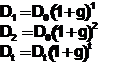
D0 = $1.15
D1 = 1.15 (1 + 8%) ^1 = $1.24 – for next year
D2 = 1.15 (1 + 8%) ^2 = $1.34 – for 2nd year
D3 = 1.15 (1 + 8%) ^3 = $1.45 – for 3rd year
D4 = 1.15 (1 + 8%) ^4 = $1.56 – for 4th year
D5 = 1.15 (1 + 8%) ^5 = $1.69 – for 5th year
2. Find the current stock value (or price of the stock)
P0 (expected price) = D0 (1 + g) / rs – g
P0 = $1.15 (1 + 0.08) / (13.4% - 8%) = 23.00
P1 = $1.24 (1 + 0.08) / (13.4% - 8%) = 24.80
P2 = $1.34 (1 + 0.08) / (13.4% - 8%) = 26.80
P3 = $1.45 (1 + 0.08) / (13.4% - 8%) = 29.00
P4 = $1.56 (1 + 0.08) / (13.4% - 8%) = 31.20
P5 = $1.69 (1 + 0.08) / (13.4% - 8%) = 33.80
Total Expected Return
To find the total expected return on a stock:
r = (D1/p0) + g[2]
Security Market Line
To find the required
rate of return on the firm’s stock:
rs = rRF +
(RPM)bFirm
Dividend yield = D1/P0
Capital Gain Yield = (P1 – P0) / P0
Total Return = Dividend yield + Capital gains yield
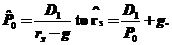 Rearranged Model for Stock Price
Price of a Stock (given PMT and r)
P0 = PMT / r
Non-Constant Growth Rate
- Supernormal
Growth – firms
that have huge growth at the beginning part of their lifecycle.
- COME
BACK TO THIS!!! (PAGE 172)
Chapter 6 – Financial Options
Option Terminology
- Option - An option is a contract which gives
its holder the right, but not the obligation, to buy (or sell) an asset at
some predetermined price within a specified period of time.
- It does not obligate its owner to take
any action. It merely gives the
owner the right to buy or sell an asset.
- In other words it is NOT a binding
contract to buy or sell the asset
- Call
option: An option to buy a specified
number of shares of a security within some future period.
- Put
option: An option to sell a specified
number of shares of a security within some future period.
- Exercise
(or strike) price: The price stated in the option contract
at which the security can be bought or sold.
- Option
price: The market price of the option contract.
- Expiration
date: The date the option matures.
- Exercise
value: The value of a call option if it were
exercised today = Current stock price - Strike price.
- Note:
The exercise value is zero if the stock price is less than the
strike price.
- Covered
option: A call option written against stock held
in an investor’s portfolio.
- Naked
(uncovered) option: An option sold without the
stock to back it up.
- In-the-money
call: A call whose exercise price is less than
the current price of the underlying stock.
- Out-of-the-money
call: A call option whose exercise price
exceeds the current stock price.
- LEAPS:
Long-term Equity AnticiPation Securities that are similar to
conventional options except that they are long-term options with
maturities of up to 2 1/2 years.
Option’s Premium Price
•
The
premium of the option price over the exercise value declines as the stock price
increases.
•
This is
due to the declining degree of leverage provided by options as the underlying
stock price increases, and the greater loss potential of options at higher
option prices.
Call Options Value
•
Current stock price: Call option value increases as
the current stock price increases.
•
Exercise price: As the exercise price increases, a call
option’s value decreases.
•
Option period: As the expiration date is lengthened, a call
option’s value increases (more chance of becoming in the money.)
•
Risk-free rate: Call option’s value tends to increase as rRF
increases (reduces the PV of the exercise price).
•
Stock return variance: Option value increases with
variance of the underlying stock (more chance of becoming in the money).
Chapter 7 – Accounting Financials
Formulas
Net
Income / Common Shares Outstanding[3]
Dividends
Paid to Common Stockholders / Shares Outstanding[4]
Total
Common Equity / Shares Outstanding[5]
(Net
Income + Depreciation + Amortization) / Shares Outstanding[6]
Subtracting operating costs from net sales, but
excluding depreciation and amortization
Net
Income – Non-cash Revenue[7]
+ Non-cash charges[8]
OR
Net
Income + Depreciation and Amortization
Five Uses of Future Cash Flows
- Pay interest on debt.
- Pay back principal on debt.
- Pay dividends.
- Buy back stock.
- Buy non-operating assets (e.g.,
marketable securities, investments in other companies, etc.)
Importance of Future Cash Flows
•
FCF is
the amount of cash available from operations for distribution to all investors
(including stockholders and debt holders) after making the necessary
investments to support operations.
•
A
company’s value depends upon the amount of FCF it can generate.
Operating Current Assets
•
Operating
current assets are the CA needed to support operations.
–
–
Cash +
Accounts Receivable + Inventories
Operating Current Liabilities
• Operating current liabilities are the CL resulting as a normal part of operations.
– Op CL include: accounts payable and accruals.
–
Accounts
Payable + Accruals
Net Operating Working Capital (NOWC)
Operating Current Assets – Operating current Liabilities
(Cash +
Accounts Receivable + Inventories) – (Accounts Payable + Accruals)
Total Net Operating Capital
(Net operating
Working Capital) + (Operating long-term assets[9])
NOPAT: Net operating profit after taxes
This is the amount of profit a company would generate if it had no debt and held no financial assets.
EBIT
(1-Tax rate)[10]
Free Cash Flows
NOPAT – Net Investment in Operating Capital[11]
Return On Investment Capital
ROIC =
NOPAT / Operating Capital
Market Value Added (MVA)
This is the difference between the market value of the firm’s stock and the amount of equity capital that was supplied by shareholders:
MVA = Market Value of Stock – Equity Capital Supplied by shareholders
MVA = (Shares
Outstanding) * (Stock Price) – Total Common Equity
Sometimes, MVA is defined as the following:
MVA = Total Market Value – Total investor-supplied capital
MVA = (Market Value of Stock + Market Value of Debt) – Total Investor-supplied capital[12]
Economic Value Added (MVA)[13]
Focuses on managerial effectiveness in a given year:
EVA = Net Operating profit after taxes (NOPAT) – After-tax dollars cost of capital used to support operations
EVA =
EBIT (1-tax rate) – (Total net operating capital)(WACC)[14]
OR
EVA =
(Operating Capital) (ROIC – WACC)
• A firm adds value if the ROIC is greater than its WACC
• Value is reduced if WACC exceeds ROIC.
Chapter 8 – Analysis of Financial Statements
Five major categories of ratios
• Liquidity: Can the firm make required payments as they become due?
• Asset management: Do we have the right amount of assets for the level of sales? Are we maintaining our fixed assets? Do we have too many current assets (idle cash, AR, Inventory?)
• Debt management: Do we have the right mix of debt and equity? How much is good for shareholders? How much increases risk too much? What is the impact on risk? On WACC?
• Profitability: Do sales prices exceed unit costs, and are sales high enough to cover operating costs as well, as reflected in PM, ROE, and ROA?
• Market value: Do investors like what they see as reflected in P/E and M/B and other ratios?
Liquidity Ratios
Current Ratio
= Current Assets[15] / Current Liabilities[16]
Creditors would like to see a high current ratio. By having a higher current ratio, creditors will be able to recollect their money if the company falls in default.
Quick Acid Ratio
= (Current Assets – Inventories) / Current Liabilities
Inventories are the lease liquid of a firm’s current assets. Losses are most likely to occur in a bankruptcy.
Asset Management Ratio
Measures how effectively the firm is managing its assets.
Inventory Turnover
= Sales / Inventory
This ratio evaluates inventory. If there is lower turn over, this means that the items are not being sold quick enough and are taking up storage. Hence, inventory does not generate revenue by being stored.
Days Sales Outstanding (DSO)
= Receivables / (Annual Sales / 365)[17]
It is known as Average Collection Period (ACP). Represents the average length of time that the firm must wait after making a sale before receiving cash, which is the average collection period.
If industry is 36 and firm is 46. It is taking the firm longer to collect A/R.
Fixed Assets Turnover Ratio
= Sales / Net Fixed Assets[18]
It measures how effectively the firm is using its plant and equipment.
Total Assets Turnover Ratio
= Sales / Total Assets[19]
It measures the turnover of all the firm’s assets. If it is below average, the company is not generating sufficient volume given its total assets investment. Sales should be increased, some assets should be sold, or a combination of these steps should be taken.
Debt Management Ratios
Debt financing, or finance leverage. It has three important implications:
1. By raising funds through debt, stockholders can maintain control of a firm without increasing their investment.
2. If the firm earns more on investments financed with borrowed funds than it pays in interest, then its shareholders’ returns are magnified, but their risk is also magnified.
3. Creditors look for the equity to provide a margin of safety.
Total Liabilities
Debt Ratio (total debt ratio) = Total Liabilities / Total Assets[20]
It measures the percentage of funds provide by sources other than equity. Creditors prefer low debt ratio. However, stockholders might want more leverage because it magnifies their expected earnings.
Times-Interest-Earned (TIE)
Times Interest Earned =EBIT / Interest Charges[21]
It measures the extent to which operating income can decline before the firm is unable to meet its annual interest cost. For example, if firm is 3.2 time and the industry is 6 times, this means the firm can cover interest 3.2 times while the industry can cover interest charges up to six times.
Profitability Ratios
It the combined effects of liquidity, asset management. And debt on operating results.
Profit Margin Sales
Profit Margin on Sales = Net Income / Sales[22]
Higher profit margins are good. If the profit margin is low, try cutting back on cost.
Basic Earning Power (BEP)
BEP = EBIT / Total Assets[23]
If the firm already has low turn over ratios and low profit margin on sales, the firm might not get a high return on its assets.
Return on Total Assets
Return on total assets = ROA = Net Income / Total Assets[24]
This ratio measures the return of total assets after taxes. If the firm haw a low percentage (%), it can result from 1) low basic earning power (BEP) plus 2) high interest costs resulting from its above use of debt.
Return on Common Equity
ROE = Net Income / Common Equity[25]
This is the most important ratio. Investors want to know how well their money is doing in terms of return. If their ROE is close to their return on total assets, the company is using their debt pretty well.
Market Value Ratios
These ratios relate the firm’s stock price to its earnings, cash flow, and book value per share.
Price/Earning Ratios (P/E)
P/E = Price per Share/Earning per Share[26]
P/E is high for firms that have strong growth prospects, other things held constant, but they are low for riskier firms.
Cash Flow per Share
= (Net Income + Depreciation) / Shares outstanding[27]
Price/Cash Flow Ratio
Price/ Cash Flow = Price per Share/Cash Flow per Share[28]
This is where cash flow is defined as net income plus depreciation and amortization. If industry is 6.8 times and the firm is 5.4 times, the firm’s growth prospect are below average, its risk is above average, or both.
Market/Book Ratio
Firms with hight rates of return on equity generally sell at higher multiples of book value than those with low returns.
First Find: Book Value Per Share
Book Value per Share = Price per Share / Cash Flow per Share[29]
If the firm’s ratio is low, again, the firm’s growth prospect is below average; its risk is above average, or both.
Second Find: Market/Book Ratio
M/B = Market Price per Share / Book Value per Share[30]
If the ratio is low, investors are willing to pay little for a dollar of the Company Name.
RATIO TABLE on Page 265
Common Size Analysis[31]
All income statement items are divided by sales, and all balance sheet items are divided by total assets.
- Each item in the income statement are shown as a percentage of sales
- Each item in the balance sheet is shown as a percentage of total assets.
- Benefit of this analysis is that you can compare the balance sheets and income statements over time and across companies.
Percent Change Analysis[32]
Growth rates are calculated for all income statement items and balance sheet accounts.
- (PRICE TODAY / BASE PRICE) – 1
or
- (PRICE TODAY – BASE PRICE) / BASE PRICE
DU PONT EQUATION
The profit margin times the total assets turn over is called the Du Pont equation, and it gives the rate of return on assets (ROA).
Return on Assets
ROA = Profit Margin x Total Asset Turn Over
ROA = (Net Income / Sales) x (Sales/Total Assets)
Example: 3.8% x 1.5 = 5.7
This means, the firm made 3.8%, or 3.8 cents, on each dollar of sales, and its assets were “turned over” 1.5 times during the year. Therefore, the company earned a return of 5.7 percent on its assets.
If the company was financed only
by common equity, then the ROE would be the same as ROA, since Total Assets =
common equity.
ROA = Net Income/Total Assets = Net Income / Common Equity = ROE[33]
This is only true if the firm
uses ONLY equity and NO debt. If the firm uses debt, common equity is less than
total assets. So ROE > ROA
Equity Multiplier
Equity Multiplier = Total Assets / Common Equity[34]
If firm uses a lot of debt, their equity multiplier will be high – the more debt they use the less equity, hence, higher equity multiplier. If the firm has $1000 in assets and is finance with $800 (80%) debt, then the equity would be $200. So 1000/200 = 5. If it only used $200 finance, then the equity multiplier would be 1000/800=1.25.[35]
Return on Equity (ROE)
Return on Equity = ROA x Equity Multiplier[36]
ROE = (Net Income / Total Assets) x (Total Assets/Common Equity)
Extended Du Pont Equation
ROE = (Profit Margin) x (Total Asset Turn Over) x (Equity Multiplier)
ROE = (Net Income / Sales) x (Sales / Total Assets) x (Total Assets / Common Equity)
The Du Pont Equation show how the profit margin, the total assets turnover, and the use of debt interact to determine the return on equity. Provides a “quick and dirty” estimate of the impact that operating changes have on returns.
How does the Du Pont System tie with shareholder value?
• The Du Pont system focuses on:
– Expense control (PM)
– Asset utilization (TATO)
– Debt utilization (EM)
• It shows how these factors combine to determine the ROE.
• DuPont is the first step in analyzing “where the problem or opportunity may lie”
• After calculating ROE using Du Pont you have an idea as to where there may be a problem or an opportunity
EVA = $NOPAT - $Cost of Capital